

Eoin Byrne
Cluster Manager, Cyber Ireland
The European Commission has formed a new Expert Group on Cluster Policy, which I was fortunate enough to be selected for.
The first meeting was held in March 2026, with members from cluster organisations, government departments and cluster experts across Europe; it set out the objectives of the Expert Group to define how clusters can contribute to the EU’s Competitiveness Compass and help shape the EU’s next cluster policy.
For Cyber Ireland, this presents a unique opportunity to demonstrate our work as international best practice and recognises our designation by the Irish Government as part of the International Impact Cluster Programme (IICP).
Clusters in Europe: A Proven Engine for Innovation and Competitiveness
Clusters have already proven to be a strategic initiative for economic development in Europe, across key sectors – from aerospace and advanced manufacturing to healthtech and cybersecurity. This is evidenced by the statistics from the European Cluster Collaboration Platform (ECCP):
- +1,200 Cluster organisations in Europe
- +150,000 companies represented
Figure: Overview of key indicators from the ECCP cluster landscape

The Draghi Report on European Competitiveness goes further: clusters account for a large share of successful commercialisation in high-tech sectors because they tightly connect researchers, start-ups, corporates and investors. This integration enables faster scaling, improved diffusion of new technologies, and more resilient value chains.
For cybersecurity, this collaborative model is essential. As threats evolve rapidly, the ecosystem must connect R&D, start-ups, large end-users, skills pipelines and public sector needs. Ireland’s cluster has proven this nationally—now the EU aims to harness this approach across borders and sectors.
A New EU Competitiveness Policy Supported by Clusters
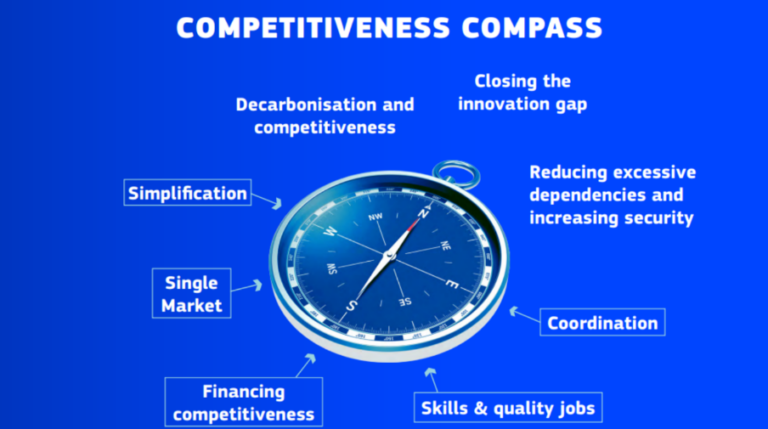
The EU Cluster policy was last updated during the 2020–2021 Industrial Strategy cycle. Since then, Europe has faced a series crises from geopolitical shocks and war, supply chain disruptions, labour shortages and accelerated technology development. The current Commission has placed competitiveness at the centre of its mandate, culminating in the new Competitiveness Compass, published in January 2025. This sets out three transformational imperatives:
- Close the innovation gap
- Decarbonise the economy
- Reduce strategic dependencies
These are supported by five horizontal enablers: simplification, Single Market integration, financing, skills, and better coordination.
The expert group aims to identify the concrete measures where clusters can deliver on these priorities—by accelerating innovation, enabling stronger industrial ecosystems, and improving competitiveness at local, national and EU scale.
EU Competitiveness Priorities and the Role of Clusters
1. Innovation, Productivity & Competitiveness
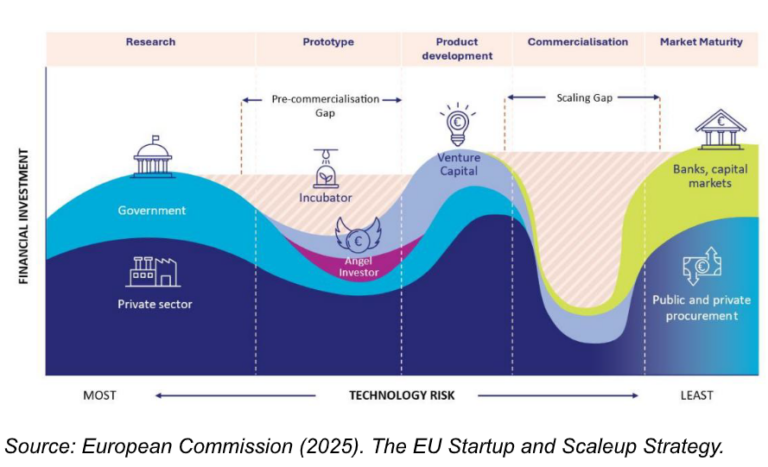
Europe continues to struggle with turning research excellence into market-ready innovation. Start-ups often scale faster in the US or Asia due to easier access to risk capital, fewer regulatory barriers, and stronger innovation ecosystems.
Clusters address this by:
- Connecting researchers with industry use cases
- Offering shared infrastructure and testbeds
- Linking start-ups with investors
For cybersecurity SMEs in Ireland, European cluster collaboration offers access to larger markets, access to capital, and collaborative innovation opportunities.
Figure: Illustration of the double “Valley of Death”
2. Economic Security & Resilience
Clusters are increasingly seen as strategic tools for Europe’s economic security. They help identify supplier gaps, build regional and cross-border value chains, and diversify technological dependencies.
Cybersecurity plays a dual role in this agenda:
- As an industrial sector requiring support to scale and compete
- As an enabling technology securing every other EU industrial ecosystem
Cyber Ireland’s mapping of Ireland’s cybersecurity industry, skills base, and capabilities mirrors the kind of ecosystem intelligence the EU now wants to develop across all strategic sectors.
3. Simplification
The Commission’s simplification agenda aims to reduce administrative burden and has introduced 10 omnibus packages to simplify regulations. The Digital Omnibus will harmonize the EU’s digital regulatory framework with the introduction of the Single Entry Reporting Portal allowing companies to fulfil reporting obligations under NIS2, GDPR, DORA, and the CER Directive simultaneously through one submission.
Clusters can support simplification by relaying regulatory feedback from industry directly to the commission, after implementation as part of ongoing monitoring and evaluation. This is particularly important in cybersecurity, where new regulations (NIS2, CRA, AI Act) challenge large and small companies alike.
Building a Future-Focused Cluster Policy
As Europe works to enhance competitiveness, close the innovation gap and strengthen economic security, clusters are recognised as strategic actors.
Through this Expert Group, we have the opportunity to shape the next decade of EU industrial policy, strengthen collaboration with European partners, and unlock new opportunities for European innovation and growth.
Cyber Ireland will contribute Irish perspectives, examples, and experiences to ensure that Europe’s evolving cluster strategy supports sectors like cybersecurity that are essential for competitiveness, resilience, and strategic autonomy.
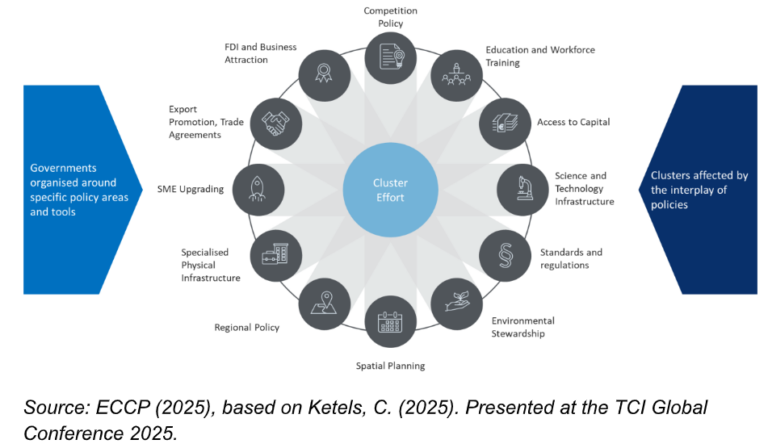
Figure: Cluster-based efforts to overcome policy fragmentation